---
title: "Routine monitoring in the Pacific: What water data looks like when hundreds of kilometres of ocean separate your communities"
description: How Akvo is building routine monitoring with UNICEF, the Ministry of Health and Majuro Water that Pacific institutions can trust, use and sustain.
image: https://datajourney.akvo.org/hubfs/cover%20image%20blog.jpg
---
[](https://akvo.org/)
- [Our approach and services](https://akvo.org/our-approach-and-services/)
- Our sectors
- [Water](https://akvo.org/water-data/)
- [Agriculture](https://akvo.org/agriculture-data/)
- [Climate](https://akvo.org/climate-data/)
- [Our work](https://akvo.org/our-work/)
- [Our blog](https://datajourney.akvo.org/blog)
- About us
- [About us](https://akvo.org/about-us/)
- [Meet our team](https://akvo.org/meet-our-team/)
- [Join our team](https://akvo.org/join-our-team/)
- [Contact us](https://akvo.org/contact-us/)
- [Get in touch](https://akvo.org/contact-us/request-a-consultation/?hsCtaTracking=337f7397-9e95-4663-9b65-73a179fb716f%7C5ae490c2-c6cb-4655-b753-05efd763ba65)
Search
x
- [Our approach and services](https://akvo.org/our-approach-and-services/)
- Our sectors
- [Water](https://akvo.org/water-data/)
- [Agriculture](https://akvo.org/agriculture-data/)
- [Climate](https://akvo.org/climate-data/)
- [Our work](https://akvo.org/our-work/)
- [Our blog](https://datajourney.akvo.org/blog)
- About us
- [About us](https://akvo.org/about-us/)
- [Meet our team](https://akvo.org/meet-our-team/)
- [Join our team](https://akvo.org/join-our-team/)
- [Contact us](https://akvo.org/contact-us/)
-
-
-
-
-
-
# Routine monitoring in the Pacific: What water data looks like when hundreds of kilometres of ocean separate your communities
Routine monitoring in the Pacific
- Written by: [Ima Puspita Sari](https://www.linkedin.com/in/ima-puspita-sari-63500832),
27 October 2026
- Share:
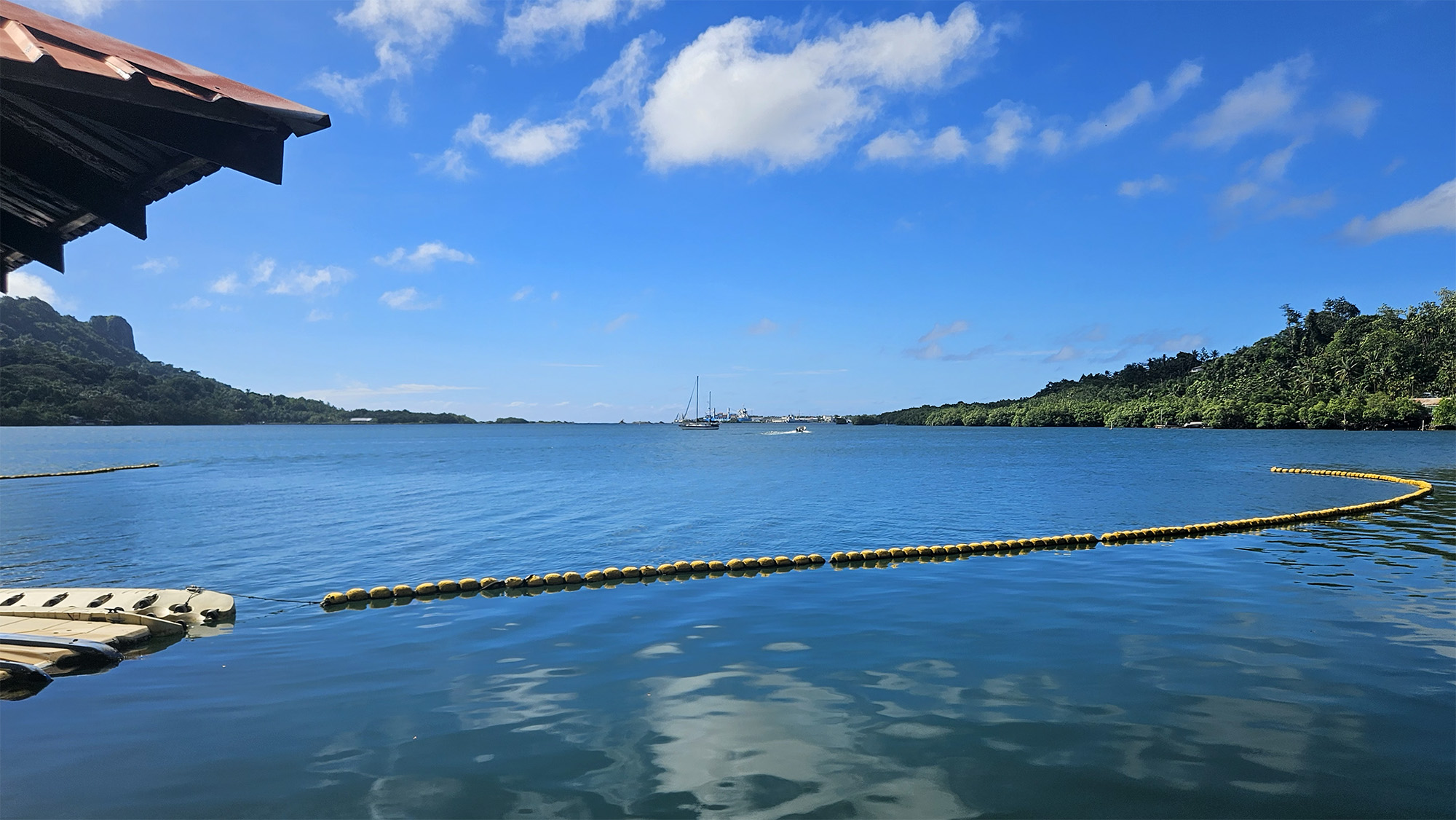
In the North Pacific, a routine monitoring question can come with a very physical constraint: the people collecting the information and the people responsible for acting on it may be separated by hundreds of kilometres of ocean. We saw this clearly during [our work in the Marshall Islands](https://akvo.org/stories/asia-pacific/building-the-foundations-for-digital-wash-monitoring-in-the-marshall-islands/).
The Ministry of Health and Human Services has health care centres spread across different atolls and islands. Reaching them takes time, planning, and significant resources. Field visits remain essential: teams need to see conditions for themselves, speak with health workers, and verify issues that cannot be assessed remotely. **A monitoring system should help make those visits count.**
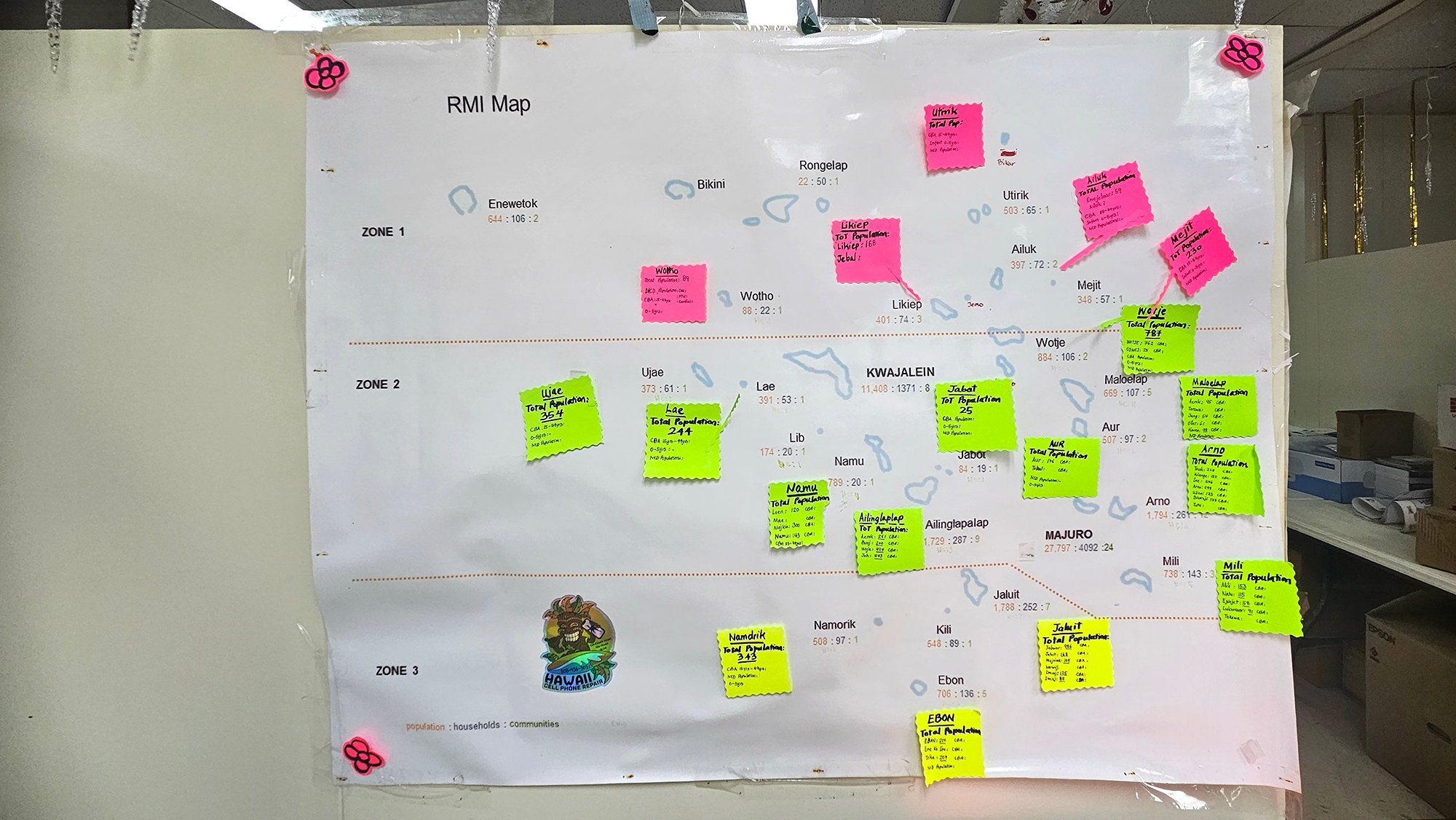
When we began working with UNICEF North Pacific and the Ministry's Outer Island Health Care Services team, the question was therefore bigger than how to digitise a form. We needed to understand which information already existed, how it moved between the outer islands and Majuro, where it became difficult to use, and which decisions the ministry needed the information to support.
These needs have shaped how the work has developed since our visit.
### 
### From separate assessments to a monitoring process
The Outer Island Health Care Services team already had assessment forms, historical records, and established ways of working. The problem was that information from different assessment rounds could be sitting in separate files, making it difficult to compare a facility over time or quickly identify where follow-up was needed. So we started there.
Together with ministry counterparts, we reviewed the existing assessment process, structured the information for digital use, and configured the monitoring workflow in Akvo's routine monitoring platform. We worked directly with Ishael Ken from Outer Island Health Care Services to test the logic, check how the assessment should work in practice, and refine the way the information is presented.
We then connected the monitoring data to analytical views that allow the team to look beyond a single assessment score. They can examine performance across different parts of a health centre, see where evidence or information is missing, review essential medicines and supplies, and start comparing results between monitoring rounds.
Historical information is now particularly important. The team has asked us to bring earlier assessment rounds into the same structure so that they can see trends at individual facilities and islands, rather than treating each visit as a separate exercise.
During our September review, Ishael reported that the digital process had already reduced the burden of collecting the information and made the workflow more efficient. The testing also revealed issues that still needed to be addressed, including synchronisation and access when connectivity is limited.
That is exactly the kind of feedback we needed at this stage: **A monitoring system becomes useful through repeated use - collecting information, seeing what works, identifying friction, and adjusting the process with the people who will operate it.**
### The technology is becoming the faster part
There is another lesson from this work that is increasingly relevant to Akvo's projects elsewhere. Building the first version of a digital workflow is much faster than it used to be.
Akvo's routine monitoring platform now gives us a reusable foundation developed through earlier monitoring systems, including our work on [real-time monitoring in Kenya](https://akvo.org/stories/east-africa/building-a-real-time-monitoring-platform-for-sanitation-and-hygiene-across-kenya/) and the [Integrated Water and Sewerage Information Management System in Fiji](https://akvo.org/stories/asia-pacific/developing-an-integrated-water-and-sewerage-management-information-system-iwsmis-in-fiji/). For the Marshall Islands, this meant we could configure the existing Outer Island Health Care Services assessment in a matter of days rather than begin a new software development project.
The same foundation can be adapted for UNICEF's water, sanitation and hygiene monitoring in health care facilities and, separately, for the WASH in Schools work now being prepared with the public school system.
That speed is valuable, but it changes where the difficult work sits. The harder questions are increasingly about the data itself.
*Which indicators are genuinely useful for routine monitoring?*
*Which information can a health assistant realistically update from an outer island?*
*Which evidence still requires a physical visit?*
*Who checks the information before it is used?*
*Which dataset becomes the authoritative record?*
*What should trigger a follow-up action?*
A dashboard built quickly does not answer those questions.
This matters as artificial intelligence, automated data processing, and reusable digital components continue to lower the technical barriers to building applications and visualisations. Organisations will be able to create more digital products, more quickly. At the same time, operational systems, sensors, and routine services will generate more information than ever.
**The risk is no longer simply that organisations do not have enough data. It is that they have more data than they can consistently manage, trust, or use.**
### 
### Majuro Water: using a prototype to discover what is actually needed
Our discussions with Majuro Water and Sewer Company have provided a different version of the same lesson.
The utility already works with operational information and expects that environment to become more complex. Daily production and meter readings, pumping stations, treatment plants, and reservoirs sit alongside customer-management information, non-revenue water monitoring, and future automated meter data.
**The concern raised during our early discussions was sensible: adding another isolated system would only create another place where information had to be maintained.**
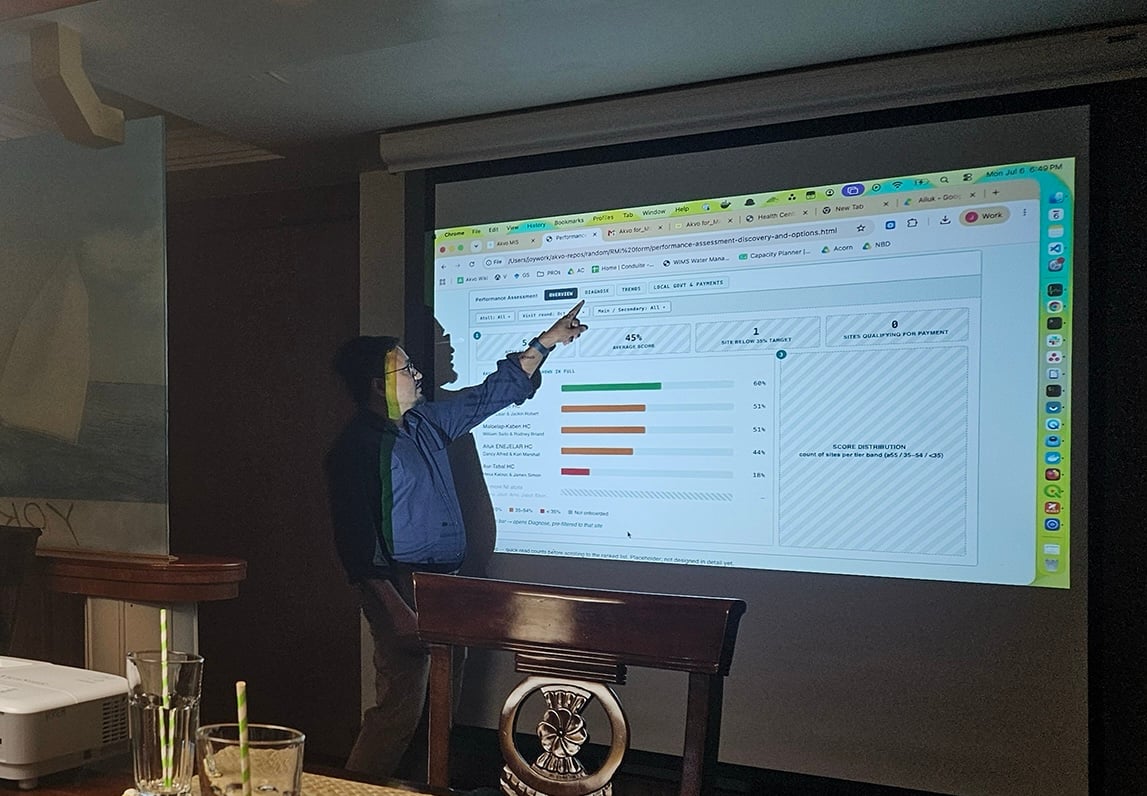
Majuro Water therefore shared its existing Water Monitor workbook with us. Instead of immediately designing a full new information system, we used the actual dataset to configure an initial proof of concept based on the Akvo platform.
The prototype organised monitoring around operational entities such as pumping stations, water treatment plants and reservoirs. It demonstrated how information could move from data entry through review and approval into management dashboards, and how the same structure could eventually support analysis such as non-revenue water.
We gave the utility access to test it. Their feedback was useful precisely because it was not simply, "this looks good." After exploring the prototype, Majuro Water told us that additional inputs would be needed before it could become a genuinely useful operational product. They also wanted to understand the likely budget before taking the work further.
This allowed the discussion to move from an abstract question - "could we build a water monitoring system?" - to much more useful questions about what was missing, what could be configured using the existing platform, what would require further development, which existing systems should remain in place, and what the overall investment would need to be.
The next step is therefore to define the priority operational requirements with Majuro Water, identify the gaps they saw during testing, and agree on a realistic phased scope and budget.
### Understand, co-create, configure, validate
These experiences are helping us make our own approach more explicit.
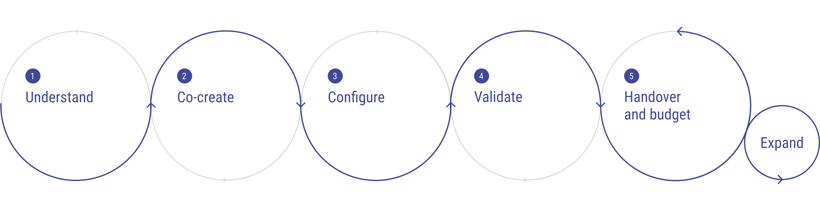
The sequence we are increasingly using is:
Understand → Co-create → Configure → Validate → Handover and budget → Expand → Enhance
**Understanding** comes first because most organisations we work with are not starting from an empty data landscape. They already have spreadsheets, forms, databases, institutional responsibilities, and reporting requirements. Some parts work well. Others do not.
**Co-creation** is where the monitoring process is defined with the people who actually collect, validate, and use the information.
**Configuration** can then happen quickly when a reusable digital foundation already exists. Validation happens through real use, not only during a demonstration.
**Handover and budgeting** need to be considered before expansion: who owns the information, who administers the system, what skills need to remain locally, and what recurring costs need to be planned for?
Only then does it make sense to **expand** the system to additional workflows or introduce more advanced capabilities such as interoperability, automated quality checks, artificial intelligence-supported analysis, or new data sources.
### 
### Improve, connect, or replace
Starting with the existing information environment also means that the answer is not always to build another system. Sometimes an existing process mainly needs to be improved. Sometimes different systems have legitimate roles and need a limited, well-defined way to exchange information. And sometimes the cost of continuing to extend an outdated or ineffective system becomes greater than replacing it. The decision depends on practical questions.
*Where is the authoritative information stored?*
*Can facilities and assets be identified consistently over time?*
*Who has permission to change a record?*
*Are indicator definitions documented?*
*Can users export and reuse their own information?*
*What data needs to move between institutions?*
*Can the organisation realistically maintain the process after the project ends?*
These questions are becoming more important as organisations accumulate more datasets and systems.
**Data governance can sound abstract until two files use different names for the same facility, two reporting processes define the same indicator differently, or nobody knows which version of a record should be trusted.** In dispersed island contexts, those small inconsistencies can become expensive. Resolving them may involve phone calls across islands, repeated data collection, or another field visit.
### A system still needs to work after the project ends
Geography also makes sustainability difficult to postpone. A donor-funded project can finance a data clean-up, a field visit, a dashboard, or specialist technical support. The ministry or utility has to operate the monitoring process afterwards with its normal staffing, connectivity, and budgets.
For the Outer Island Health Care Services work, our next conversations therefore include who should own and validate the data, who should administer the system, how routine changes to forms should be managed, and what ongoing support and budget are realistic.
The same issue is part of the Majuro Water discussion. A useful operational system should not make the utility dependent on continuous bespoke development from an external provider. This is also why reusable and configurable technology matters. A routine change to an indicator should not automatically become a software-development project.
Local ownership, however, requires more than handing over login credentials. It requires clear roles, documented processes, data standards, training, appropriate technical administration, and a recurring budget for the parts of the system that genuinely need continued support.
## What the North Pacific is teaching us
Our work in the North Pacific is still developing. The Outer Island Health Care Services monitoring workflow is being refined and expanded with new and historical information. WASH in Schools provides another opportunity to test the same underlying approach with a different government programme. Majuro Water is at an earlier stage, where the prototype has helped clarify the requirements and the conversation now needs to move to scope and investment.
The common lesson is becoming clearer. Digital transformation is increasingly less about whether a form, dashboard, or application can be built. The real work lies in designing a data process that an institution can trust, use, and sustain.
In the North Pacific, the consequences are particularly visible. When communities and public services are separated by hundreds of kilometres of ocean, weak information flows are not merely inconvenient. They consume scarce time, staff capacity, and travel budgets.
Good digital monitoring will not eliminate the need to go to the outer islands, nor should it. It should help teams know more before they go: which facilities are reporting, where conditions have changed, what information is missing, and which problems genuinely require someone to be there in person.
That is a much more useful test of whether the technology is working.

### Ima is a Project manager at Akvo, based in Denpasar
[LinkedIn](https://www.linkedin.com/in/ima-puspita-sari-63500832)
Posted in: [Water](https://datajourney.akvo.org/blog/tag/water), [Data services](https://datajourney.akvo.org/blog/tag/data-services), [Tech services](https://datajourney.akvo.org/blog/tag/tech-services)
### You might also like...
#### [The missing layer: Why local knowledge is essential to climate resilience](https://datajourney.akvo.org/blog/the-missing-layer-why-local-knowledge-is-essential-to-climate-resilience)
- July 13th, 2026
#### [How winning a global innovation challenge validated two decades of open thinking](https://datajourney.akvo.org/blog/how-winning-a-global-innovation-challenge-validated-two-decades-of-open-thinking)
- June 16th, 2026
#### [The Gender Data Gap in the Year of the Woman Farmer](https://datajourney.akvo.org/blog/the-gender-data-gap-in-the-year-of-the-woman-farmer)
- April 29th, 2026
#### [Building open tech for public good](https://datajourney.akvo.org/blog/building-open-tech-for-public-good)
- November 4th, 2025
##### About
- [Meet our team](https://akvo.org/meet-our-team/)
- [Our vision and mission](https://akvo.org/our-vision-and-mission/)
- [Join our team](https://akvo.org/join-our-team/)
- [Our legal entities](https://akvo.org/our-legal-entities/)
- [Media and press](https://akvo.org/media-and-press/)
- [Strategic partnerships and consortia](https://akvo.org/strategic-partnerships-and-consortia/)
##### Our regional hubs
- [Americas](https://akvo.org/americas/)
- [West Africa](https://akvo.org/west-africa/)
- [East Africa](https://akvo.org/east-africa/)
- [Asia Pacific](https://akvo.org/asia-pacific/)
##### Our services
- [Our approach and services](https://akvo.org/our-approach-and-services/)
- [Knowledge library](https://akvo.org/knowledge-library/)
##### Tech solutions
- [Help and support](https://akvo.org/help-and-support/)
- [Data platform updates](https://akvo.org/data-platform-updates/)
- [Data platform status](https://akvo.statuspage.io/)
- [Vulnerability Disclosure Policy](https://akvo.org/vdp/)
##### General
- [Terms of service](https://akvo.org/terms-of-service/)
- [Policies and legal documents](https://akvo.org/policies/)
- [FAQ](https://akvo.org/faq/)
- [Contact us](https://akvo.org/contact-us/)
- [Our blog](https://datajourney.akvo.org/blog)
##### Our expertise
- [Agriculture](https://akvo.org/agriculture/)
- [Water](https://akvo.org/water/)
- [Climate](https://akvo.org/climate/)
-
-
-
-
-
-
We apply the principles of open source software, open content and open data to all of our work.
Find out [why and how](https://akvo.org/blog/open-data-content-and-software-at-akvo/).