---
title: How winning a global innovation challenge validated two decades of open thinking
description: Last year, Akvo was selected as one of five winners of the DPI4PP Innovation Challenge 2025 - here's what we learned.
image: https://datajourney.akvo.org/hubfs/DPI4PP%20blog%20cover.png
---
[](https://akvo.org/)
- [Our approach and services](https://akvo.org/our-approach-and-services/)
- Our sectors
- [Water](https://akvo.org/water-data/)
- [Agriculture](https://akvo.org/agriculture-data/)
- [Climate](https://akvo.org/climate-data/)
- [Our work](https://akvo.org/our-work/)
- [Our blog](https://datajourney.akvo.org/blog)
- About us
- [About us](https://akvo.org/about-us/)
- [Meet our team](https://akvo.org/meet-our-team/)
- [Join our team](https://akvo.org/join-our-team/)
- [Contact us](https://akvo.org/contact-us/)
- [Get in touch](https://akvo.org/contact-us/request-a-consultation/?hsCtaTracking=337f7397-9e95-4663-9b65-73a179fb716f%7C5ae490c2-c6cb-4655-b753-05efd763ba65)
Search
x
- [Our approach and services](https://akvo.org/our-approach-and-services/)
- Our sectors
- [Water](https://akvo.org/water-data/)
- [Agriculture](https://akvo.org/agriculture-data/)
- [Climate](https://akvo.org/climate-data/)
- [Our work](https://akvo.org/our-work/)
- [Our blog](https://datajourney.akvo.org/blog)
- About us
- [About us](https://akvo.org/about-us/)
- [Meet our team](https://akvo.org/meet-our-team/)
- [Join our team](https://akvo.org/join-our-team/)
- [Contact us](https://akvo.org/contact-us/)
-
-
-
-
-
-
# How winning a global innovation challenge validated two decades of open thinking
- Written by: [Joy Ghosh](https://www.linkedin.com/in/joyghosh83/), [Emeline Bereziat](https://www.linkedin.com/in/emeline-bereziat-603a7628/),
16 June 2026
- Share:
Digital Public Infrastructure (DPI) is gaining serious momentum at the highest levels of global policy - and for good reason. For too long, digital solutions in international development meant procuring a proprietary system from a large vendor, leaving governments unable to inspect, modify, or walk away without significant cost. Data collected in one country ended up in databases owned and controlled somewhere else entirely, and when the funding ran out - as it always does - the systems collapsed. DPI, built on open standards, interoperability, and national ownership, is a direct response to that pattern.
Last year, Akvo was selected as one of five winners of the [DPI4PP Innovation Challenge 2025](https://www.linkedin.com/company/dpi4pp/) - the world's first innovation challenge built around this thinking. We shared that news at the time, but we didn't share why the experience mattered: both as a confirmation of nearly two decades of building open technology for public good, and as a learning experience in translating open principles into deployable, scalable public infrastructure. We want to share those lessons now.
### **What is the DPI4PP Innovation Challenge?**
The Digital Public Infrastructure for People and Planet (DPI4PP) Innovation Challenge is the world's first innovation
challenge focused specifically on the intersection of people, planet, and DPI. It was hosted by JICA, Co-Develop, the Gates Foundation, the Centre for Digital Public Infrastructure, and Boston Consulting Group, in partnership with the COP30 Presidency. The challenge invited innovators from around the world to propose scalable solutions that use Digital Public Infrastructure to address pressing environmental and societal challenges - particularly in low- and middle-income and climate-vulnerable communities.
### **What Akvo brought to the table**
Akvo has spent nearly two decades building open digital infrastructure for the management of public goods. Across all of it, the same structural problem recurs: distributed public assets are managed blind, because the data that should describe them lives in fragmented, incompatible silos owned by different agencies. Nobody has a complete picture of what exists, where, and in what condition. The result is reactive management, wasted resources, and the people who depend on that infrastructure left to bear the cost.
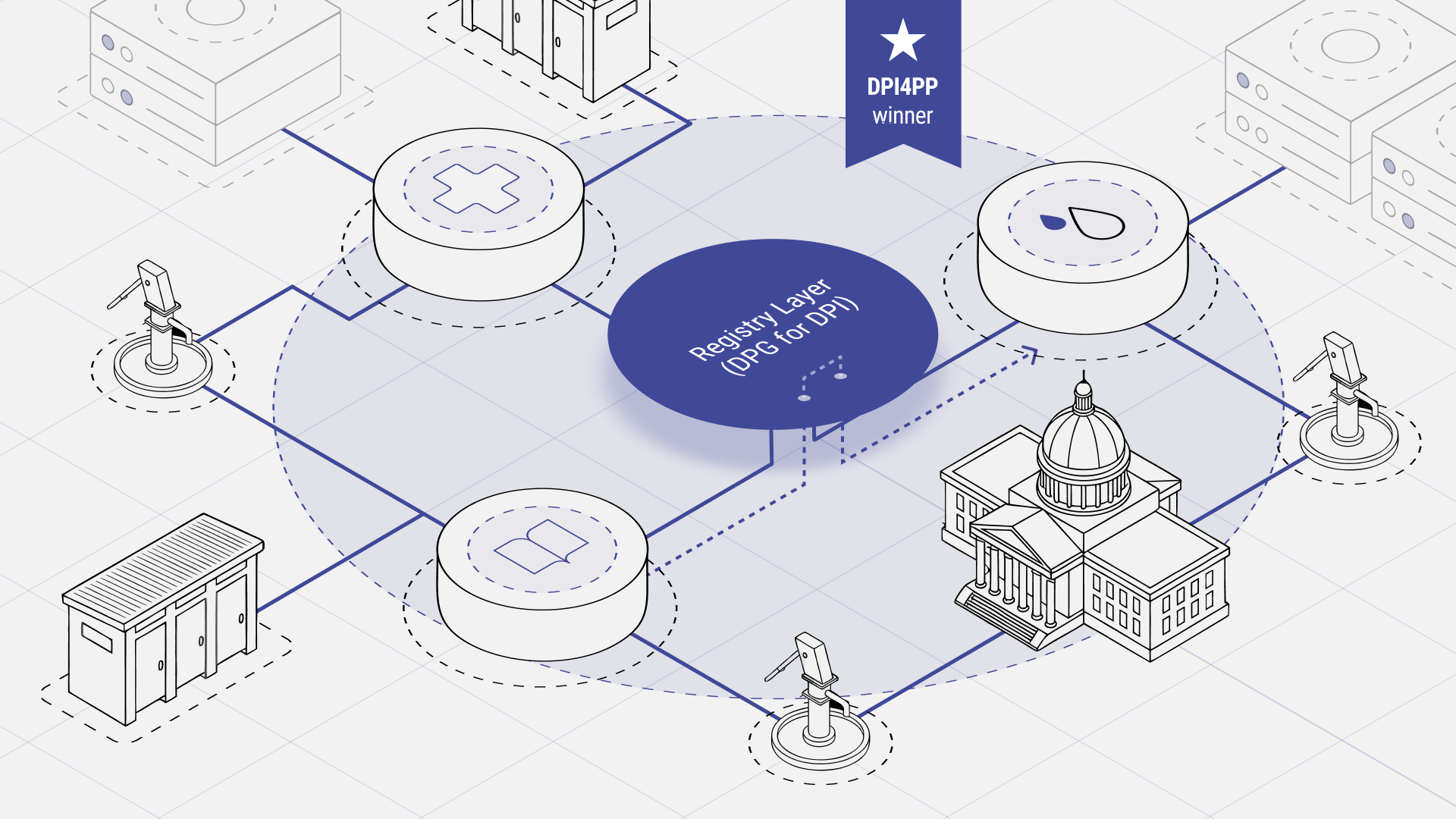
We won the DPI4PP challenge with the [Unique WASH ID](https://akvo.org/wp-content/uploads/2026/02/Unique-WASH-ID.pdf) - a digital public infrastructure designed to tackle one of the most persistent and underappreciated problems in the water and sanitation sector. Every public WASH asset - every waterpoint, pump, and public toilet - gets a unique digital identity. Crucially, this does not replace existing databases. It connects them, creating a digital thread that links all assets without any agency having to give up control of their data. The Ministry of Health keeps tracking water quality in their system. The water utility keeps managing operations in theirs. But now they are both talking about the same tap, the same pump, the same waterpoint - because it carries the same unique ID.
In Liberia, where Akvo has worked directly with the WASH Commission for over a decade, this is not a theoretical proposition. It is something we are actively building with the government, grounded in trust earned over years. And that trust points to something concrete: country ownership. A [recent article in the Stanford Social Innovation Review](https://ssir.org/articles/entry/scaling-global-health-innovations) argues that real country ownership is not the same as partnership or "hand-off." It means governments retain control over data, decisions, and adaptations - so that systems survive when donors leave. The Unique WASH ID is designed for exactly this: open source, open standards, federated. It removes dependency, rather than creating a new one.
### **Under the hood**
At its core, the Unique WASH ID registry operates as a lightweight, "phone book" architecture - deliberately minimal to serve as foundational infrastructure rather than a comprehensive data warehouse. Built on Sunbird RC, an open-source registry and credentialing framework, the system maintains a single source of truth for each water point, sanitation facility, or hygiene asset - assigning it a persistent identifier that travels with it across its lifecycle. Think of it as a national index: when a borehole is registered, it receives a unique ID that links to essential attributes - GPS coordinates, facility type, administrative location, managing entity. Other systems can then reference this ID when recording pump maintenance, water quality tests, or usage data, without duplicating master records. The registry exposes APIs that allow upstream systems (like HMIS platforms or community-reporting tools) to verify an ID exists, pull basic attributes, or push status updates, while credential-based access controls ensure that visibility respects user role and jurisdiction. This separation of identity from transactional data is what positions it as Digital Public Infrastructure: lightweight, interoperable, and designed to reduce the fragmentation that currently plagues WASH data ecosystems across sub-Saharan Africa.
### **How the challenge worked - and what it sharpened**
The challenge ran over several months. It opened with a rigorous application process that required us to articulate not just what the Unique WASH ID does, but why it qualifies as genuine Digital Public Good for Digital Public Infrastructure and how it could scale. Selected participants then went through rounds of mentorship with technical experts, government representatives, and development agencies who pushed hard on architecture, governance, and sustainability. It culminated in a final pitch alongside teams working across sectors from disaster resilience to sustainable agriculture. Winning the challenge was gratifying - but the real value was in the months that preceded it.
The clearest demonstration of that value was the Global DPI Summit in Cape Town. Being in a room with the leading architects, policymakers and practitioners working on Digital Public Infrastructure from across the world was unlike anything else in the challenge. It was the kind of concentrated learning and peer exchange that is very hard to manufacture, and it left a mark on how we think about what we are building and where it sits in a much larger global movement. A few things stand out.
**On digital sovereignty**
The challenge pushed us to treat it not as a design feature but as a political and ethical commitment. The federated model we use for the Unique WASH ID means agencies never send us their databases - they maintain full control and expose only specific data points through secure APIs. Governments in low- and middle-income countries have very good reason to be cautious about who holds their data. DPI done right should eliminate that concern at the architectural level, not paper over it with reassurances.
**On replicability**
Spending time alongside teams working on carbon markets, disaster resilience, and sustainable agriculture deepened our conviction that what we are building in water is not sector-specific. A unique digital identity for public assets, a federated model, a public API ecosystem – these are building blocks that apply wherever fragmented data is blocking effective management of public goods.
**On sustainability**
There is a long history in our sector of systems built on donor funding, handed over, and quietly abandoned when the money runs out. Our open core model - where the core registry is free and open, and premium features fund the ecosystem that keeps it alive - is a direct response to that pattern. The challenge's emphasis on deployable, scalable solutions rather than one-off prototypes affirmed that this is the right way to think about it.
### **Why this matters beyond water**
The Unique WASH ID is a WASH solution, but the infrastructure thinking behind it is not sector-specific. At its core, it is an asset registry - a way to give every piece of public infrastructure a digital identity so it can be tracked, maintained, and coordinated across institutions. That pattern applies far beyond water. Any sector that manages distributed public assets and suffers from fragmented data faces the same structural problem. That is what DPI means in practice: not a bespoke system built for one government or one donor, but modular, reusable infrastructure that can be adapted, extended, and built upon.
### **What's next**
Our immediate priority is deepening the pilot in Liberia, working alongside the WASH Commission to embed the Unique WASH ID into the national data management system. From there, backed by our global partnership with UNICEF and with discussions already underway in ten countries, we are working towards scaling the approach internationally.
But it is worth stepping back for a moment. Akvo has been making the case for open source, open data, and national ownership of digital infrastructure since 2006. Our [co-founder Thomas Bjelkeman-Pettersson wrote about it as far back as 2013](https://akvo.org/blog/open-data-content-and-software-at-akvo/), arguing that IT infrastructure would become just as important for a country's governance as its roads or sanitation systems - and that governments needed to own it on the same terms. That thinking has shaped everything we have built since: open-source products, open standards, APIs by default, and a business model designed to reduce donor dependence rather than entrench it.
What DPI4PP showed us was that a much larger global conversation had arrived at the same conclusions. Being alongside governments, development agencies, and technologists all converging on these principles was energising.
Ultimately, what the DPI4PP challenge confirmed is something Akvo has believed since 2006. The Unique WASH ID is one proof of that principle. The pattern it embodies - unique identities for public assets, federated data, open APIs, no new dependencies - is replicable wherever fragmented data is blocking the effective management of public goods. That is what we are building toward.
If you are curious about our approach, the Unique WASH ID, or the lessons we have taken from the DPI4PP experience, we would love to hear from you.
*Emeline Bereziat is Akvo’s Water Lead, and is based in France. Joy Ghosh is Akvo’s Tech Lead, and is based in Bali.*
*Learn more about the Unique WASH ID* [*here*](https://akvo.org/wp-content/uploads/2026/02/Unique-WASH-ID.pdf)*.*

### Joy Ghosh is Akvo's Tech Lead and is based in Bali, Indonesia.
[LinkedIn](https://www.linkedin.com/in/joyghosh83/)
Posted in: [Water](https://datajourney.akvo.org/blog/tag/water), [Data services](https://datajourney.akvo.org/blog/tag/data-services), [Tech services](https://datajourney.akvo.org/blog/tag/tech-services)
### You might also like...
#### [The Gender Data Gap in the Year of the Woman Farmer](https://datajourney.akvo.org/blog/the-gender-data-gap-in-the-year-of-the-woman-farmer)
- April 29th, 2026
#### [Building open tech for public good](https://datajourney.akvo.org/blog/building-open-tech-for-public-good)
- November 4th, 2025
#### [Harnessing AI to address complex societal problems - use cases, risks, and future trajectories](https://datajourney.akvo.org/blog/harnessing-ai-to-address-complex-societal-problems)
- May 23rd, 2025
#### [Seeking truth: Sharing our experience from collecting data around the world](https://datajourney.akvo.org/blog/seeking-truth-sharing-our-experience-from-collecting-data-around-the-world)
- December 18th, 2024
##### About
- [Meet our team](https://akvo.org/meet-our-team/)
- [Our vision and mission](https://akvo.org/our-vision-and-mission/)
- [Join our team](https://akvo.org/join-our-team/)
- [Our legal entities](https://akvo.org/our-legal-entities/)
- [Media and press](https://akvo.org/media-and-press/)
- [Strategic partnerships and consortia](https://akvo.org/strategic-partnerships-and-consortia/)
##### Our regional hubs
- [Americas](https://akvo.org/americas/)
- [West Africa](https://akvo.org/west-africa/)
- [East Africa](https://akvo.org/east-africa/)
- [Asia Pacific](https://akvo.org/asia-pacific/)
##### Our services
- [Our approach and services](https://akvo.org/our-approach-and-services/)
- [Knowledge library](https://akvo.org/knowledge-library/)
##### Tech solutions
- [Help and support](https://akvo.org/help-and-support/)
- [Data platform updates](https://akvo.org/data-platform-updates/)
- [Data platform status](https://akvo.statuspage.io/)
- [Vulnerability Disclosure Policy](https://akvo.org/vdp/)
##### General
- [Terms of service](https://akvo.org/terms-of-service/)
- [Policies and legal documents](https://akvo.org/policies/)
- [FAQ](https://akvo.org/faq/)
- [Contact us](https://akvo.org/contact-us/)
- [Our blog](https://datajourney.akvo.org/blog)
##### Our expertise
- [Agriculture](https://akvo.org/agriculture/)
- [Water](https://akvo.org/water/)
- [Climate](https://akvo.org/climate/)
-
-
-
-
-
-
We apply the principles of open source software, open content and open data to all of our work.
Find out [why and how](https://akvo.org/blog/open-data-content-and-software-at-akvo/).